
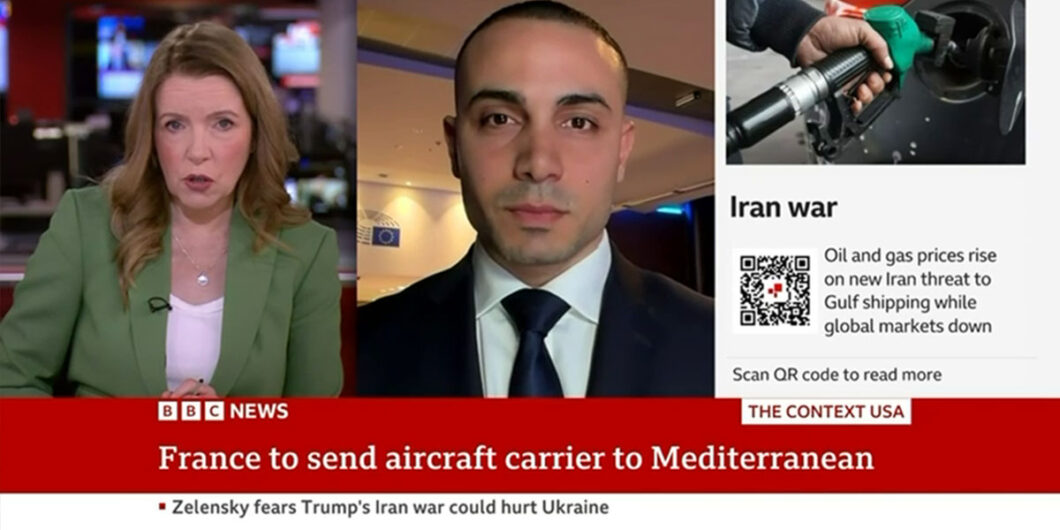
Maltese Labour MEP Daniel Attard, who also serves as Vice Chair of the European Parliament’s Delegation for relations with Iran, is playing a significant role in discussions within the European Parliament on the rapidly evolving situation in the region. In this context, Attard was interviewed yesterday evening by BBC News to discuss the crisis from the perspective of the European Parliament.
During the interview, BBC journalist Annita McVeigh first asked Attard for his reaction to comments made by US President Donald Trump regarding the United Kingdom and Spain, and in particular remarks directed at UK Prime Minister Keir Starmer when Trump stated that “we are not confronting Churchill”.
Attard responded that references to Winston Churchill serve as a reminder of the importance of multilateralism and the international order that emerged after the Second World War. He stressed that he preferred to focus on those principles rather than on comments directed at specific individuals. Attard noted that the United States, Europe and the United Kingdom share decades of strategic partnership and fundamental values. For that reason, he expressed confidence that the transatlantic relationship is strong enough to withstand moments of tension and that it will endure beyond the current crisis.
When asked about the actions taken by the United States and Israel, Attard acknowledged that serious legal questions have been raised. However, he stressed that it is important to remember that the Iranian regime has spent decades destabilising the region, supporting militias and repressing its own population. For this reason, he said, the regime bears primary responsibility for the current crisis. Sovereignty, he added, should never be used as a shield by a regime that has imprisoned and killed its own citizens in order to remain in power.
McVeigh also referred to comments by President Trump suggesting that it may now be too late for Iran to engage in negotiations. She asked Attard whether he believed diplomacy was still possible.
The Maltese MEP replied that he would prefer ten years of diplomacy to a single day of war. As a Member of the European Parliament, he said he would continue to advocate for diplomacy and believes that Europe should play a leading role in pursuing it. Europe’s first responsibility is to protect its citizens, but it must also take the initiative in facilitating dialogue that can ultimately lead to de-escalation. Attard stressed that Europe must work to reopen a path towards diplomacy because alternatives to conflict always exist. For years, he added, the European Parliament has called for such alternatives, including tougher sanctions against the Iranian regime. These sanctions have begun to have an effect, and even the European Council has increasingly aligned with the Parliament’s position. Diplomacy, Attard concluded, must always prevail.
McVeigh noted that there have been several occasions where Europe and the United States have struggled to align on diplomatic approaches, citing recent disagreements on issues such as Greenland and Ukraine. She asked whether the United States and Israel would be willing to accept European leadership in efforts to restore diplomacy.
Attard replied that Europe must not remain a spectator. Instead, Europe must persuade its partners by remaining consistent with its values and by strengthening its strategic autonomy. However, he stressed that strategic autonomy should not be interpreted as hostility towards the United States. Strategic partnership, he concluded, should not mean strategic dependence.